
When WordPress released Gutenberg in 2018, the backlash was loud — and it came almost entirely from bloggers.
They hated the new interface. They clung to the Classic Editor plugin like a life raft. They wrote thousands of words explaining why the Block Editor made writing harder, slower, and more frustrating.
And they were right. It did make writing harder.
But here is the thing nobody said out loud at the time: bloggers were never who the Block Editor was built for.
Let’s Go Back to 2016

By 2016, WordPress powered roughly 25% of the web. That sounds impressive until you look at what was happening around it.
Squarespace was running sleek TV ads. Wix had a drag-and-drop builder that anyone could use without touching a line of code. Weebly was signing up small businesses by the thousands. And inside the WordPress ecosystem, Elementor — a third-party page builder — was growing faster than WordPress itself.
The message was clear: people did not just want a place to write. They wanted a place to build.
Automattic, the company behind WordPress.com, was watching all of this. And they had a problem.
WordPress’s editing experience — TinyMCE, a basic rich text box that had barely changed in a decade — was built for writers. It was terrible for building pages, landing pages, business sites, or anything that required layout control. Every time someone wanted a two-column section or a custom hero block, they needed a plugin, a page builder, or a developer.
That was the gap Gutenberg was designed to close. Not for bloggers. For everyone else.
What Gutenberg Was Actually Competing With
Matt Mullenweg, co-founder of WordPress, has said publicly that Gutenberg’s goal was to make WordPress competitive with modern website builders. The block-based approach — where every element on a page is a discrete, moveable, configurable block — is not a writing interface. It is a visual layout system.
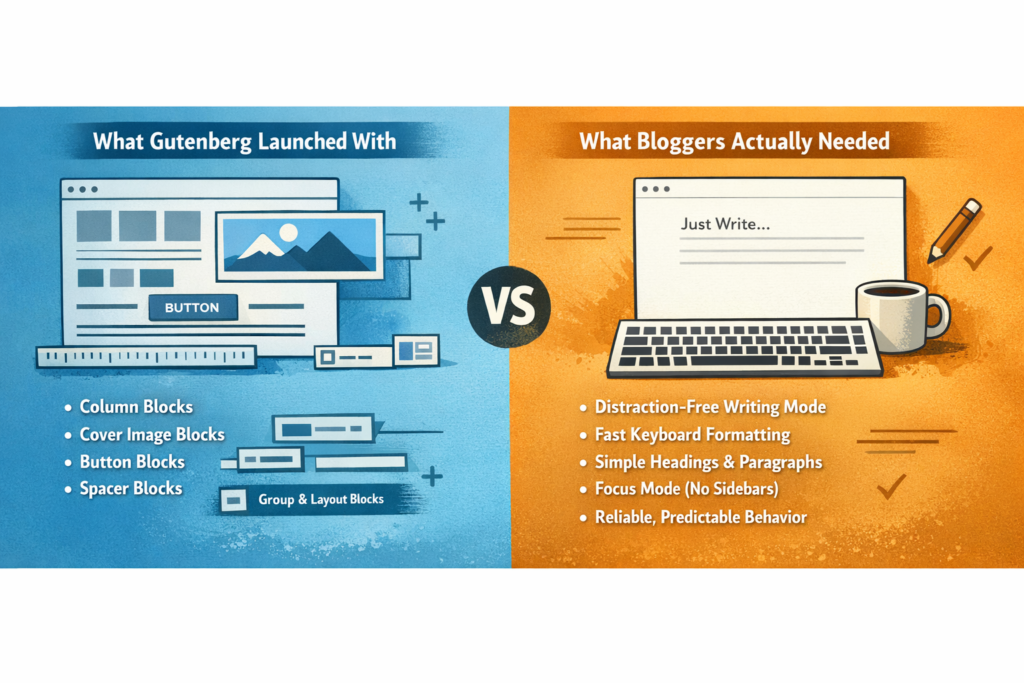
Compare what Gutenberg launched with versus what a blogger actually needs:
| What Gutenberg launched with | What bloggers actually needed |
|---|---|
| Column blocks | A distraction-free writing mode |
| Cover image blocks | Fast keyboard-driven formatting |
| Button blocks | Simple heading and paragraph styles |
| Spacer blocks | Focus mode (no sidebars) |
| Group and layout blocks | Reliable, predictable behavior |
Notice anything? The first version of Gutenberg was packed with features for page design, not writing. Column layouts, cover images, buttons, spacers — these are tools for building a homepage, not drafting a 1,500-word post.
Bloggers were collateral damage in a product decision aimed at an entirely different market.
Full Site Editing Proved It
If there was any remaining doubt about who Gutenberg was for, Full Site Editing (FSE) removed it.
Introduced in WordPress 5.9 in 2022, FSE extended the block system beyond posts and pages into the entire theme — headers, footers, sidebars, templates, everything. With FSE, you could build and edit your entire site without touching PHP or CSS.
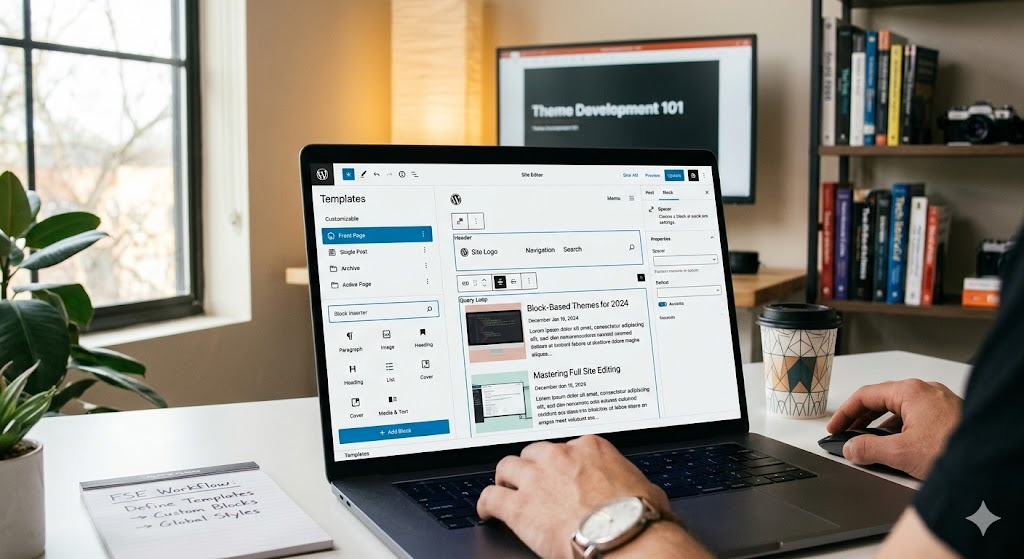
That is not a blogging feature. That is a site builder feature.
FSE directly targeted what Squarespace and Wix had been doing for years: giving non-developers full visual control over every part of their website. Automattic was not building a better writing tool. They were building a competitor to an entirely different category of product.
The roadmap made this obvious in retrospect. Phase 1 of Gutenberg was the block editor. Phase 2 was Full Site Editing. Phase 3 is collaboration. Phase 4 is multilingual support. None of these phases were designed around the needs of someone who opens WordPress every morning to write a blog post.
So What Does This Mean for Bloggers?
Two things.
First, the Block Editor is genuinely good now — just not for the reasons bloggers originally wanted. If you are building a site, a landing page, a portfolio, or a small business website on WordPress, the block system is significantly better than it was in 2018. The writing experience has also improved, even if it is still not as clean as something like iA Writer or even a basic Markdown editor.
Second, bloggers now have more options than ever to work around it. The Classic Editor plugin still works (though its long-term future is uncertain). Tools like Stackable, Kadence Blocks, and GenerateBlocks extend the block system for people who do want design control. And if you just want to write, plugins like Mammoth or even direct Markdown import let you draft elsewhere and publish to WordPress without living inside Gutenberg.
The ecosystem adapted. It just took a few painful years to get there.
The Real Lesson
WordPress’s story with Gutenberg is a clean example of what happens when a platform outgrows its original audience.
WordPress started as blogging software. But by 2018, the majority of WordPress sites were not blogs — they were business websites, e-commerce stores, portfolios, and landing pages. The platform had to evolve to serve that majority, even if it meant friction for the vocal minority who still used it the original way.
Bloggers were not wrong to be frustrated. But they were frustrated at a product that was no longer being built for them — and that is a different kind of problem than a bad product decision.
The Block Editor was not a failure of execution. It was a deliberate pivot toward a larger market. Understanding that does not make the transition less painful, but it does make it make sense.
One More Thing
If you have spent any time inside WordPress — as a blogger, developer, marketer, or site owner — you have probably felt this tension firsthand. The platform trying to be everything to everyone, and occasionally being exactly what nobody wanted.
I write about this kind of thing regularly — WordPress, content strategy, and what actually works when you are building something online. If that sounds useful, drop your email below and I will send you the next one when it is ready.

hi